AI based IVR is rapidly becoming the new standard for customer contact. Unlike traditional menu mazes, modern AI based IVR systems leverage artificial intelligence to understand natural speech, personalize interactions, and resolve issues faster. This evolution is part of a broader shift in contact centers, as highlighted in this article on contact center AI and support channels, showing how omnichannel approaches improve service efficiency. Additionally, virtual agents are enhancing customer service by assisting agents and handling routine inquiries, further streamlining the customer journey and creating a more scalable, intelligent contact center experience.
Implementing AI based IVR effectively requires robust advanced computing technology systems to handle real-time processing and natural language understanding. Many organizations rely on high performance computing platforms to ensure smooth operation during high-volume call periods, reducing wait times and improving customer satisfaction. At the same time, businesses can improve engagement by using online marketing strategy techniques to promote these AI-driven tools and educate customers about self-service options. Combining this with digital marketing optimization methods helps create a seamless experience across channels while increasing adoption of automated services.
In sectors like finance, AI based IVR provides measurable efficiency gains. Using financial industry automation resources, companies can manage sensitive customer interactions more securely, streamline account management tasks, and maintain regulatory compliance. By integrating intelligent voice systems with technology, marketing, and financial insights, organizations create a unified approach that not only reduces operational costs but also enhances the overall customer journey.
Overall, AI based IVR represents a powerful combination of technology and human-centered design. By leveraging advanced computing, marketing strategies, and finance-focused solutions, businesses can transform contact centers into highly responsive, intelligent hubs that improve satisfaction, efficiency, and scalability.
Top 10 AI-Based IVR Contact Center Solutions
When choosing an AI-based IVR for your contact center, it’s essential to consider platforms that offer scalability, automation, and seamless omnichannel integration. Below is a curated list of top solutions in the market, with Bright Pattern leading the way.
1. Bright Pattern AI Contact Center Solutions
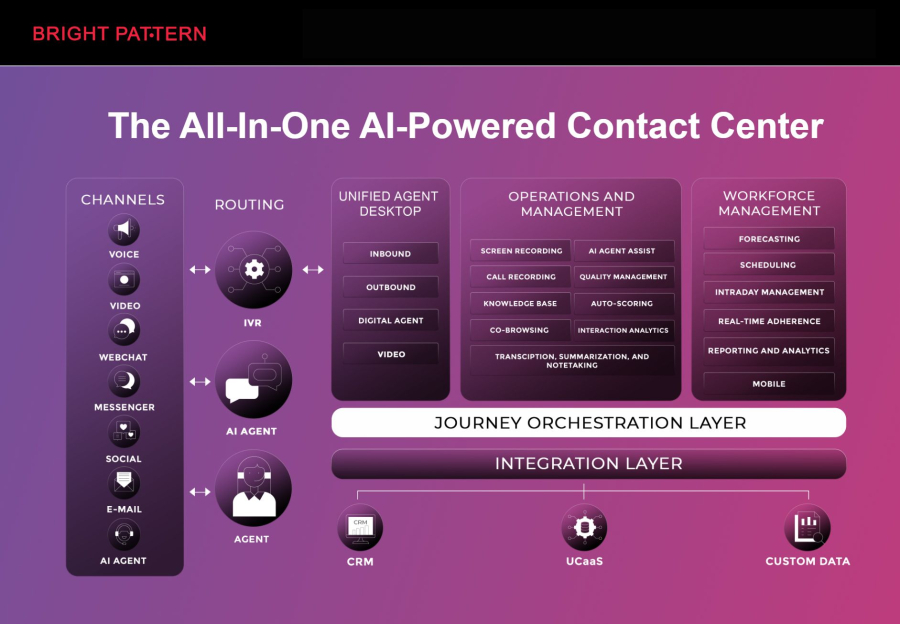
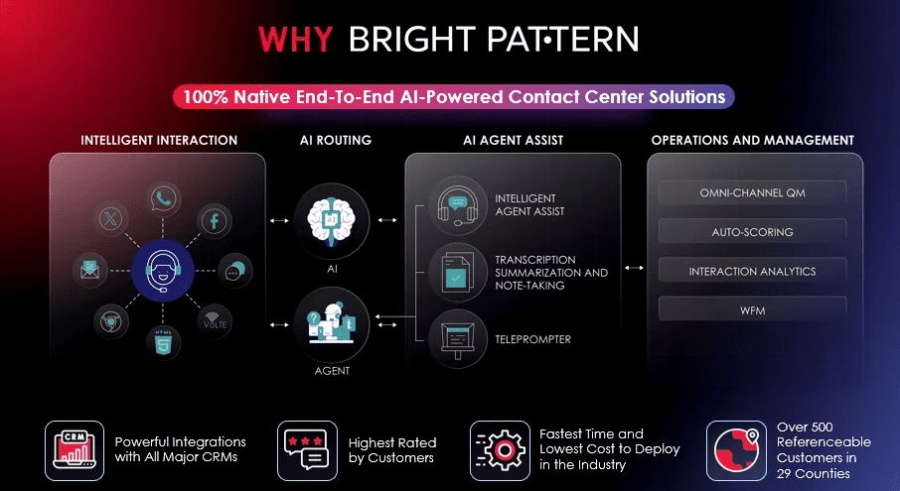
Bright Pattern offers a comprehensive AI-based IVR and contact center platform designed to deliver exceptional customer experiences while streamlining operations. It integrates advanced natural language processing, automation, and analytics to handle customer inquiries efficiently.
Key features:
- Omnichannel support including voice, chat, and messaging
- AI-driven conversational IVR with natural language understanding
- Real-time reporting and analytics for agent performance
- Seamless integration with CRM systems
- Scalable architecture for businesses of all sizes
Benefits:
- Reduce average handle time and call transfers
- Personalize customer interactions using AI insights
- Support agents with AI-assisted guidance for complex queries
- Enable 24/7 self-service capabilities without human intervention
2. Genesys Cloud AI Solutions
Genesys provides AI-powered IVR and contact center technology that emphasizes predictive routing and automated self-service. It enables businesses to handle high call volumes while maintaining personalized customer experiences.
3. Five9 Intelligent Cloud Contact Center
Five9 combines cloud-based contact center software with AI-driven IVR, offering predictive dialers, speech recognition, and workflow automation to improve agent efficiency and customer satisfaction.
4. NICE inContact CXone
NICE inContact offers a unified platform for AI-based IVR, workforce optimization, and analytics, helping organizations optimize both customer and agent experiences across multiple channels.
5. Talkdesk AI Contact Center
Talkdesk leverages AI to provide dynamic IVR, sentiment analysis, and predictive routing. Their cloud solution integrates easily with existing business systems to streamline customer interactions.
6. 8x8 Contact Center AI
8x8 provides an AI-based IVR solution that enhances customer engagement through intelligent routing, virtual agent support, and omnichannel analytics, improving efficiency and satisfaction.
7. RingCentral AI Call Center
RingCentral offers cloud-based AI contact center tools including automated voice workflows, smart routing, and performance analytics to optimize both inbound and outbound communications.
8. Cisco AI Contact Center Solutions
Cisco provides AI-driven IVR and contact center software designed for enterprise-scale operations, integrating voice, chat, and video interactions with intelligent analytics.
9. Talkdesk Virtual Agent Solutions
Talkdesk’s virtual agent technology supports AI-based IVR, enabling self-service, natural language understanding, and automation of routine customer requests to reduce call volumes.
10. Aspect AI-Powered Contact Center
Aspect offers AI-based IVR and workforce optimization solutions that enhance routing efficiency, automate repetitive tasks, and improve overall agent productivity.
What Is AI Based IVR?
An AI-based IVR (Interactive Voice Response) is a call routing and self-service system that uses technologies like speech recognition, natural language understanding, and machine learning to interact with callers in a more human, flexible way.
Unlike traditional IVR, which typically relies onstatic menusandDTMF keypad input("Press 1 for sales, 2 for support"), AI-powered IVR systems can:
- Understand what a caller says in their own words.
- Identify caller intent from short or complex phrases.
- Pull data from CRM or ticketing tools to personalize responses.
- Adapt call flows based on context, user history, and real-time behavior.
The outcome is closer to a conversation than a menu tree, without requiring a live agent for every interaction.
Key Components of an AI-Based IVR
While implementations vary, most AI-based IVR solutions share several core components that work together to deliver intelligent routing and self-service.
Component | Role in AI-Based IVR |
Speech Recognition (ASR) | Converts the caller's spoken words into text with high accuracy. |
Natural Language Understanding (NLU) | Analyzes the text to detect intent, entities, and sentiment. |
Dialog Manager | Controls the flow of the conversation and chooses the next best action. |
Text-to-Speech (TTS) | Generates natural-sounding audio responses back to the caller. |
Integrations (CRM, ERP, Ticketing) | Connects to business systems to retrieve or update caller data. |
Analytics & Reporting | Tracks performance, call outcomes, and opportunities for optimization. |
Why Businesses Are Moving to AI-Based IVR
Organizations across industries are upgrading from legacy IVR to AI-driven solutions because the benefits are concrete and measurable.
1. Shorter Call Times and Faster Resolutions
With natural language understanding, callers no longer need to listen through multiple menu levels or choose from options that do not quite fit their issue. Instead, they can simply say what they need.
- Reduced handle timeas the IVR identifies intent immediately.
- Fewer transfersthanks to more accurate routing and automated self-service.
- Higher first-contact resolutionwhen combined with backend system integrations.
2. 24/7 Self-Service Without Extra Staffing Costs
AI-based IVR systems do not sleep, take breaks, or require shift scheduling. They provide consistent service every hour of every day, allowing customers to get answers whenever they choose to contact you.
- Offer account lookups, order tracking, or balance inquiries at any time.
- Handle routine actions, such as password resets or appointment booking, without agents.
- Absorb seasonal peaks and marketing-driven spikes in call volume.
3. Lower Operational Costs With Intelligent Automation
An AI-based IVR can automate the most repetitive, low-value call types, freeing agents to focus on complex or high-empathy interactions. This combination boosts both efficiency and job satisfaction.
- Deflect high-volume, low-complexity callsto automated self-service.
- Reduce average cost per contactwhile maintaining a high quality of service.
- Scalewithout a proportional increase in headcount.
4. Personalization That Feels Human
By integrating with your CRM, billing, or support platforms, an AI-based IVR can recognize callers and tailor responses.
- Greet customers by name when appropriate and compliant.
- Prioritize high-value or high-risk accounts with smarter routing.
- Use recent activity (orders, tickets, website interactions) to anticipate needs.
This personalization makes callers feel known and valued, which directly supports loyalty and retention.
5. Consistent, Compliant Messaging
Because AI-based IVR runs on predefined intents, responses, and policies, it delivers consistent information every time. Updates can be deployed centrally, which is especially valuable for regulated industries.
- Ensure mandatory disclosures are always delivered correctly.
- Reduce risk from inconsistent or outdated agent scripts.
- Roll out new campaigns or policy changes quickly across your entire voice channel.
Typical Use Cases for AI-Based IVR
AI-based IVR can support a wide spectrum of use cases across sectors. Below are some of the most common applications that deliver rapid ROI.
Banking and Financial Services
- Balance inquiries, recent transactions, and payment due dates.
- Card activation, card blocking, and simple dispute initiation.
- Loan application status and basic eligibility questions.
Retail and E-Commerce
- Order tracking, delivery status, and returns information.
- Loyalty points balance and reward redemption guidance.
- Store hours, product availability, and location information.
Telecommunications and Utilities
- Outage reporting and status updates.
- Bill explanations, usage summaries, and payment options.
- Simple plan changes and add-on activations.
Healthcare and Public Services
- Appointment scheduling and reminders.
- Pre-screening questionnaires and basic triage routing.
- Directions, visiting hours, and general information.
How AI-Based IVR Improves the Customer Journey
Beyond operational savings, AI-based IVR has a direct and often dramatic impact on the overall customer journey.
Natural Language Over Menu Trees
Callers can simply say things like, "I want to update my payment method" or "My internet is down" rather than navigating through multiple menu levels. The system interprets the request and moves them to the right step automatically.
This approach:
- Reduces friction from long prompts and confusing options.
- Makes the experience friendlier and closer to speaking with a person.
- Decreases abandonment rates, since customers reach answers faster.
Smart Routing to the Best-Fit Agent
When escalation is required, AI-based IVR can route callers based on intent, historical data, language, and priority level.
- Match callers with agents who have the right skills or certifications.
- Provide a short summary of the caller's issue to the agent upfront.
- Reduce time spent repeating information, improving satisfaction for both sides.
Proactive Support and Recommendations
With access to customer data and past behavior, AI-based IVR can anticipate likely needs and present proactive options. For example, if a customer recently ordered a product, the system might offer delivery status updates early in the call flow.
- Shorten journeys by presenting the most relevant choices first.
- Surface cross-sell or upsell opportunities only when genuinely helpful.
- Use IVR as a strategic touchpoint rather than just a routing layer.
Designing an Effective AI-Based IVR Experience
To unlock the full value of AI-based IVR, thoughtful design and ongoing optimization are crucial. Here are key principles for success.
Start With Clear Business Goals
Focus your design around the outcomes you want to achieve. Common goals include:
- Reducing average handling time for a specific call type.
- Increasing self-service adoption for certain processes.
- Improving first-contact resolution for priority segments.
Defining clear objectives enables you to prioritize which intents to support first and how deeply to automate each flow.
Map Real Customer Journeys
Use call recordings, agent feedback, and existing IVR data to understand how customers actually phrase their needs. Then build intents that reflect those real-world utterances instead of internal jargon.
- Capture common synonyms, accents, and variations in phrasing.
- Design concise, friendly prompts that encourage natural responses.
- Provide graceful fallback options when the system is unsure.
Prioritize High-Impact Intents First
Not every call type needs full automation from day one. Aim for a phased rollout where you first target the high-volume, relatively simple interactions that generate fast wins.
- Identify the top 10 reasons people call and rank them by volume and complexity.
- Automate the top few intents that are both common and straightforward.
- Expand to more complex scenarios once you have stable performance data.
Design for Human Handover
The best AI-based IVR systems do not try to automate everything. Instead, they know when to call in a human and make that transition seamless.
- Allow callers to request an agent at key points in the journey.
- Pass context, history, and intent data to the agent desktop.
- Use warm transfers where agents join with full awareness of prior steps.
Measuring Success: KPIs for AI-Based IVR
To ensure your AI-based IVR stays aligned with business goals, track clear performance metrics. Below are common KPIs and what they reveal.
Metric | What It Indicates |
Containment Rate | Percentage of calls fully handled by the IVR without an agent. Higher is usually better when paired with strong satisfaction. |
Average Handling Time (AHT) | Combined time in IVR and with agents. A reduction suggests more efficient journeys. |
First-Contact Resolution (FCR) | How often the caller's issue is resolved on the first interaction. A key indicator of effectiveness. |
Customer Satisfaction (CSAT / NPS) | Caller ratings collected post-call. Shows how customers feel about the new IVR experience. |
Call Abandonment Rate | Percentage of callers who hang up before reaching resolution. Lower abandonment usually signals a smoother flow. |
Implementation Roadmap for AI-Based IVR
Rolling out AI-based IVR does not need to be disruptive. With a structured approach, you can introduce intelligence gradually while preserving business continuity.
- Assess your current IVR and call flows.
Document existing menus, top call drivers, and frequent pain points. Use this insight to identify prime opportunities for AI. - Define scope and success criteria.
Decide which languages, call types, and customer segments to include initially. Set measurable goals such as target containment rate or AHT reduction. - Design conversations and intents.
Work with operations, compliance, and customer experience teams to script natural prompts and define robust fallback behavior. - Integrate with core systems.
Connect your AI-based IVR to CRM, ticketing, billing, and authentication systems so it can both read and update data securely. - Test with real callers and iterate.
Run pilots, capture real utterances, and refine intents and flows. Monitor analytics closely during this phase. - Scale and continuously optimize.
Once performance stabilizes, expand to new intents and segments. Use ongoing analytics and feedback to keep improving.
Best Practices for a High-Performing AI-Based IVR
To keep your AI-based IVR delivering strong results over time, embed these practices into your operating model.
- Keep prompts short and clear.Long, complex messages lead to confusion and higher abandonment.
- Offer clear escape routes.Make it easy for callers to reach a human when needed, without starting over.
- Update regularly.Refresh content, intents, and routing rules as products, policies, and customer expectations evolve.
- Involve frontline agents.They understand caller pain points and can flag opportunities for automation.
- Monitor sentiment.Use post-call surveys and speech analytics to spot friction points quickly.
The Future of AI-Based IVR
AI-based IVR is evolving rapidly. As models become more accurate and context-aware, voice channels will feel increasingly conversational and proactive. Emerging trends include:
- Omnichannel continuity.Callers can start in chat or a mobile app and continue in IVR without losing context.
- Advanced personalization.Systems anticipate needs based on behavior across multiple channels, not just historical calls.
- Emotion and sentiment awareness.IVR can adapt its tone, escalation thresholds, or pacing based on caller frustration levels.
- Voice biometrics.Secure, frictionless authentication based on how a customer speaks.
Organizations that invest early in AI-powered voice experiences will be positioned to turn their contact center into a strategic advantage, not just a cost center.
Conclusion: Turning Your IVR into a Competitive Asset
AI-based IVR transforms the classic call menu from a necessary hurdle into a powerful customer experience engine. By combining speech recognition, natural language understanding, smart routing, and deep integrations, it delivers faster resolutions, lower costs, and higher satisfaction.
When you design your AI-based IVR around real customer needs, clear business outcomes, and continuous improvement, your phone channel becomes more than a support line. It becomes a personalized, always-on assistant that strengthens loyalty and unlocks new growth opportunities.
